

Carbon Assessment: From Passive Compliance to Active Carbon Reduction
On April 23, the "Carbon Peak and Carbon Neutrality Comprehensive Evaluation and Assessment Measures" was issued, officially incorporating carbon emission intensity into rigid constraints. Skyworth ESS's "SuperEarn" solution offers a path forward for energy-intensive businesses.
On April 23, 2026, the General Office of the CPC Central Committee and the General Office of the State Council officially issued the "Carbon Peak and Carbon Neutrality Comprehensive Evaluation and Assessment Measures" (hereinafter referred to as the "Measures"). This heavyweight document, known in the industry as the "dual-carbon assessment form," marks China's transition from "target guidance" to "rigid assessment" in carbon reduction.
The core changes of the "Measures" lie in three "firsts": for the first time, carbon emission intensity is included in Party and government assessments; for the first time, a "5+9" indicator system is established; and for the first time, the "15th Five-Year Plan" targets are clarified — achieving carbon peak before 2030, reducing carbon emission intensity by more than 65% compared to 2005, and raising the share of non-fossil energy consumption to 25%.
For industrial and commercial enterprises, this means that carbon reduction has shifted from a "social responsibility" to a "compliance obligation." At the operational level, the core issues facing enterprises are: how to achieve carbon targets while controlling electricity costs.
Skyworth ESS research has found that under the new carbon assessment rules, energy-intensive enterprises generally face a "carbon-electricity dilemma" — carbon emission indicators and electricity costs constrain each other, making it difficult to balance both.
Pain point 1: Low photovoltaic consumption, with green electricity "generated but unused." A large number of enterprises have installed rooftop photovoltaics, but during the midday peak generation period, factory load is insufficient, green electricity cannot be sold at a good price or even experiences negative electricity prices, resulting in a serious imbalance between input and output.
Pain point 2: Large fluctuations in peak-valley price differences, making arbitrage windows difficult to grasp. Various regions' peak-valley electricity price policies are frequently adjusted, with multiple changes in time period division and price difference ranges. Enterprises lack professional energy management capabilities and find it difficult to accurately predict and seize arbitrage opportunities.
Pain point 3: Poor coordination between source, grid, load, and storage, with low overall energy efficiency. Photovoltaic power generation systems, mains electricity systems, and energy storage charging and discharging systems often operate independently, lacking a unified scheduling platform.
Pain point 4: Complicated power trading, with uncertain long-term returns. With the nationwide rollout of the electricity spot market, intraday electricity price fluctuations have intensified. Business owners who are unfamiliar with trading rules and lack price prediction capabilities often passively accept market electricity prices.
The four pain points combined put enterprises in a dilemma: they must meet both carbon targets and control electricity costs — but existing energy systems cannot achieve "both."
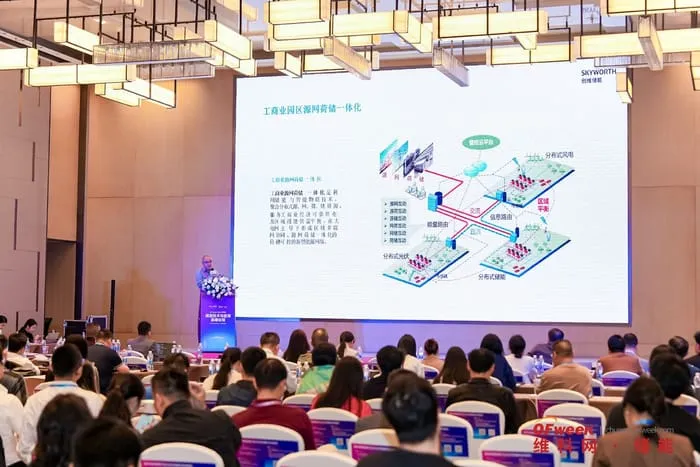
As early as the 6th Energy Storage Technology and Application Summit Forum, Dr. Deng Bo of Skyworth ESS systematically demonstrated the company's comprehensive energy solution based on digital twins, AI, and cloud big data in his speech titled "From Island to Symbiosis — Skyworth's Source-Grid-Load-Storage & Zero-Carbon Park."
The "SuperEarn" comprehensive energy management system, built on the "computing-power synergy" architecture, is Skyworth ESS's systematic answer to the dual-carbon challenge. Through AI algorithms, it achieves second-by-second optimization of energy flow, helping enterprises find the optimal balance between carbon indicators and electricity bills.